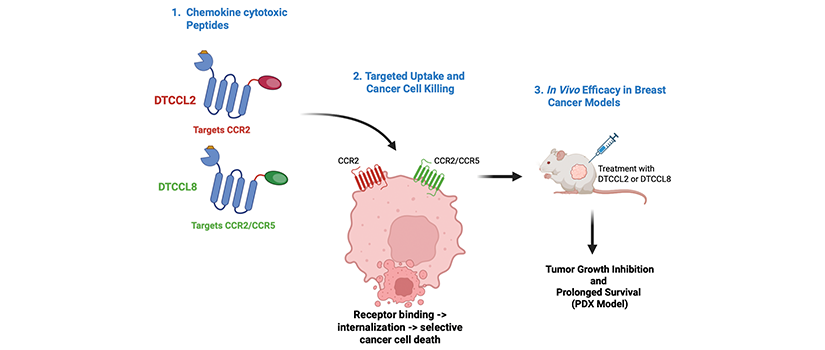
Researchers studied new cancer-fighting proteins designed to target breast cancer cells. Chemokine receptors help cancer start and grow, but many of these receptors and their signaling molecules overlap, making them difficult to target with treatments. To address this problem, the researchers created two modified proteins, called DTCCL2 and DTCCL8, by combining cancer-targeting molecules (CCL2 and CCL8) with diphtheria toxin. They tested these proteins in breast cancer cells grown in the laboratory and in mice with breast tumors.
The results showed that both DTCCL2 and DTCCL8 were able to kill breast cancer cells and slow tumor growth. In laboratory tests, most cancer cells absorbed both proteins, while a smaller number did not absorb one or either treatment. In tumor samples taken from mice, more than 95% of cancer cells absorbed at least one of the proteins. Mice treated with DTCCL2 or DTCCL8 had slower tumor growth and lived longer than untreated mice. These findings suggest that these modified proteins could become a useful treatment for breast cancer and that laboratory tests alone may not accurately predict how well tumors will respond to therapy.
|
2. |
Chavez B, Sikirzhytski V, Lim CU, Chatzistamou I, Kiaris H. Cancer Biol Ther. IMPACT FACTOR: 5.7 2026 Dec 31;27(1):2688479. doi: 10.1080/15384047.2026.2688479. Epub 2026 Jul 2. PMID: 42390481 |