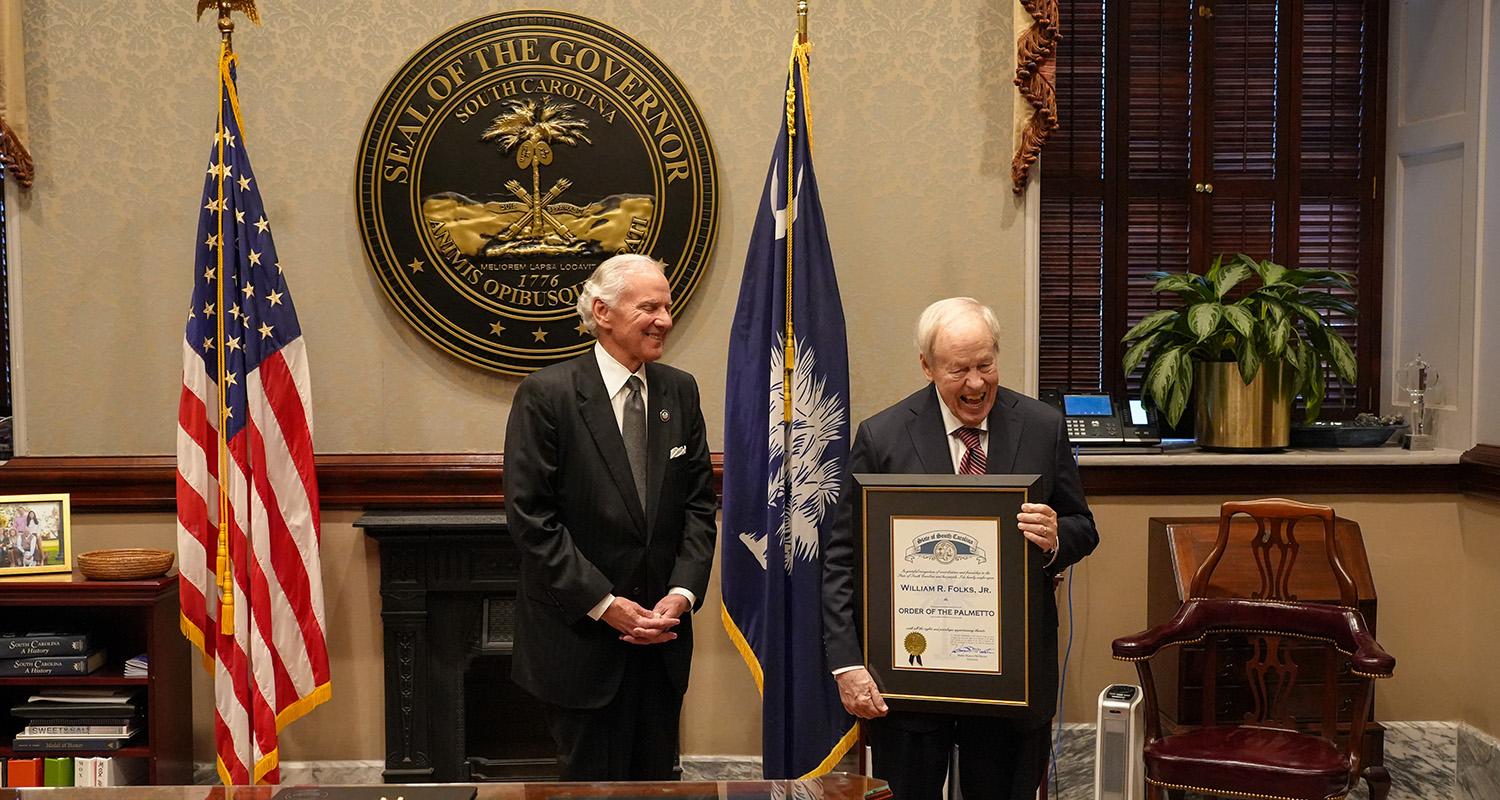
William Randolph Folks Jr., distinguished professor emeritus of international business at the University of South Carolina Darla Moore School of Business, was presented with the Order of the Palmetto in a surprise ceremony at the State House on Nov. 5.
“It is unprecedented at the University of South Carolina for a faculty member to create a program from scratch that revolutionizes education, but Dr. Folks has done just that,” former Gov. Jim Hodges wrote in his nomination letter to Gov. Henry McMaster. “Importantly, our international programs remain a top destination for students and scholars from across the world.”
The Order of the Palmetto is the state’s highest civilian honor and recognizes a person’s extraordinary service to South Carolina.
After earning his doctorate from Harvard Business School, Folks joined the USC faculty in 1969 and helped launch the Master of International Business program in 1974. In 1976, he became the founding chair of the Department of International Business.
He also was instrumental in launching USC’s undergraduate international business major, which has been ranked No. 1 among American universities for 28 consecutive years since its inception.
“Randy was instrumental in building innovative international programs that have helped generations of students see the world as a place where they can build careers and make a difference,” says Moore School Interim Dean Gregory Niehaus. “His work has demonstrated that a business school can be both deeply rooted in South Carolina and connected to the world. We’re proud to see his commitment to South Carolina recognized with the Order of the Palmetto.”
Further enhancing USC’s international stature, Folks served as director of the Center for International Business Education and Research (CIBER) at USC, one of 15 institutions nationwide belonging to the federal Centers for International Business Education and Research. Furthermore, he was named the first president of the Association for International Business Education and Research.
In 2015, the Folks Center for International Business was established in his name to support the Moore School's international business initiatives, including trade and diplomacy forums that bring world-renowned global experts to the school to share their knowledge with students.
Folks’s longtime friend and colleague Kendall Roth, executive director of CIBER at USC, submitted a letter supporting the award nomination.
“Randy has dramatically influenced thousands of students at USC, preparing them for exceptional professional careers around the globe,” Roth wrote. “As a result, these alumni have represented our state as ambassadors in their respective industries. … He has been the focal and visionary force that has built the international business capacities of our university.”
It is not a coincidence that the rise in foreign-direct investment in our state coincided with our focus on global business education at the Moore School. His work has led to new capital investment and jobs in our state.
In 2008, Folks was named a Fellow in the Academy of International Business, which also honored him as International Business Educator of the Year. He followed up in 2015 by establishing the Folks Center for International Business at USC, which facilitates immersive global learning experiences for students and collaborates with multinational organizations to analyze international issues that impact strategy, innovation, workforce and leadership.
“He took USC from a regional institution to a world-recognized leader in international business education, and in doing so, he brought enormous credit and economic benefit to the people of South Carolina,” state Sen. Tom Davis wrote in his endorsement of the nomination.
More recently, the Columbia World Affairs Council honored Folks with its Global Vision Award, and he was inducted into the Moore School Hall of Fame.
“Dr. Folks makes our state and university shine on the international stage,” Gov. Hodges wrote in his nomination letter. “It is not a coincidence that the rise in foreign-direct investment in our state coincided with our focus on global business education at the Moore School. His work has led to new capital investment and jobs in our state.”